
Quick answer by country
Follow the country first, then the job advert. If an advert or application form asks for a photo, add one. If it says not to, don’t. Everything in this table is a convention, not a law, and conventions change, so the advert always wins.
| Country | Photo on your CV? | What the guidance says |
|---|---|---|
| United Kingdom | Leave it off | Unnecessary unless you’re applying for acting or modelling work (Prospects) |
| Ireland | Only if asked | Supply one only if the application form requests it (EURES Ireland) |
| United States | Leave it off | If an employer needs a photo for identification, it can be obtained after a job offer is made and accepted (US EEOC) |
| Canada | Leave it off | Don’t include a picture of yourself; it isn’t the norm (Job Bank, Government of Canada) |
| Australia | Leave it off | Listed under what to leave out, with age and marital status (University of Queensland careers guide) |
| Germany | Common, still optional | A friendly photo with a neutral background remains part of a typical application (EURES Germany) |
| Austria | Common, still optional | An application photograph is listed as part of a complete application (EURES Austria) |
| Switzerland | Common, still optional | A complete application includes a CV with a photograph (EURES Switzerland) |
| France | Optional | Not required: the EURES France guide’s list of CV sections has no photo, and French law bars hiring discrimination based on physical appearance (France Travail) |
| Belgium | Usually leave it off | No photo unless the job requires it or the employer asks (EURES Belgium) |
| Netherlands | Optional | The official CV guidance lists what to include and doesn’t mention a photo (EURES Netherlands) |
| Spain | Optional | Not compulsory, though it may be useful for some jobs (EURES Spain) |
| Portugal | Optional, often welcome | Including a photo is often appreciated (EURES Portugal) |
| Italy | Only if asked | No need to attach one unless it’s specifically requested (EURES Italy) |
| Sweden | Optional, common | Common, but not a requirement; if you include one, make it look professional (Øresunddirekt, Arbetsförmedlingen) |
| Finland | Optional, common | Not mandatory, but quite common these days (EURES Finland) |
| Denmark | Recommended | Danish companies notice the photo and profile text first; include a professional picture (Workindenmark) |
| Norway | Optional | The official guide doesn’t mention a photo (EURES Norway) |
| Europass | Optional | The editor lets you add one, and Europass’s own tips suggest a professional photo (Europass) |
Applying in English to an international employer?
Look at the application form. If it has no photo field and the advert doesn’t mention one, leaving the photo off is a sensible default, even in countries where photos are common.
Why UK and Irish employers prefer no photo
No UK law bans photos on CVs. They’re rare mainly because of equality law and the bias it exists to prevent. Under the Equality Act 2010, section 39, an employer must not discriminate against an applicant in the arrangements it makes for deciding who to offer a job to. Section 4 lists 9 protected characteristics: age, disability, gender reassignment, marriage and civil partnership, pregnancy and maternity, race, religion or belief, sex, and sexual orientation.
A photo hints at several of these before anyone has read a word about your experience, so UK careers advice is consistent on this point:
- Prospects, the UK graduate careers service, says a photo is unnecessary unless you’re applying for acting or modelling roles.
- The National Careers Service tells you not to include your age, date of birth, marital status or nationality.
- GOV.UK’s guidance for employers says they must not ask candidates about protected characteristics, and may only ask for a date of birth if the job has a genuine age requirement.
The Equality Act covers England, Scotland and Wales. Northern Ireland has its own equality laws, explained by the Equality Commission for Northern Ireland.
Ireland works in a similar way. The Employment Equality Acts cover job applicants and outlaw discrimination in access to employment on 9 grounds, including gender, age, race, disability and membership of the Traveller community (Workplace Relations Commission). EURES’s guide to Ireland says you only need a photograph if the form asks for one.
North America takes the same line. The US Equal Employment Opportunity Commission says a photo needed for identification can be collected after a job offer has been made and accepted, and Canada’s Job Bank says a photo is simply not the norm. If you’re converting a CV for those markets, our CV vs resume guide covers the other changes.
For the UK and Ireland, put the space to better use: a clear profile and strong, specific experience. Our guide on how to write a CV covers each section in order.
Mainland Europe in more detail
Germany, Austria and Switzerland
This is where photos are most expected. EURES, the EU’s job-mobility portal, describes a friendly application photo with a neutral background as part of a German application, and lists a photo in the standard application package for Austria and Switzerland.
It’s still your choice. No law requires you to send a photo, and Germany’s General Equal Treatment Act aims to prevent discrimination on grounds including ethnic origin, sex, religion, disability, age and sexual identity (AGG, § 1). It expressly covers job applicants (§ 6). If you include one, make it a good one; if you don’t, make sure the rest of the CV is complete.
France and Belgium
In France a photo is optional. Physical appearance is one of the criteria French employment law forbids discrimination on (summarised by France Travail), and EURES’s France guide lists the expected CV sections without one. Belgium leans further towards no photo: EURES’s Belgium guide says to leave it off unless the job requires it or the employer asks, and to skip private details such as age, nationality and marital status.
Spain, Portugal and Italy
Southern Europe is mixed. For Spain, EURES says a photo isn’t compulsory but may be useful for some jobs. For Portugal, it says a photo is often appreciated. For Italy, it says there’s no need to attach one unless it’s specifically requested.
The Netherlands and the Nordic countries
In the Netherlands a photo is optional: the EURES guide sets out what a Dutch CV should contain and doesn’t mention one. For Sweden, Øresunddirekt, the public information service for the Swedish–Danish Øresund region, says photos are common but not required, and the Swedish Public Employment Service, Arbetsförmedlingen, advises a professional-looking one if you include it. EURES says much the same for Finland. For Denmark, Workindenmark, the official service for international jobseekers, advises including a professional picture, because Danish companies notice it first. The EURES guide for Norway doesn’t mention photos.
For CV length, personal details and the Europass format country by country, see our European CV format guide.
If you include a photo: 8 rules
A CV photo should look like the person who will walk into the interview, on a good working day. These rules cover almost every case:
- Recent. It should look like you do now: same hair, same glasses, roughly the same age.
- Head and shoulders, facing the camera. Frame it from just above your head to just below your shoulders.
- A plain, neutral background. A light wall works well and keeps the attention on you.
- Soft, even light. Face a window in daylight. Avoid harsh overhead light, flash and strong shadows.
- Dress as you would for the interview. Plain colours usually look calmer than busy patterns.
- A natural, friendly expression. A slight smile is fine. EURES’s Germany guide itself talks about a “friendly” photo.
- No selfies, holiday snaps, cropped group photos or heavy filters. Ask someone to take it at eye level instead.
- Leave space around your face. Many photo slots are round and cut off the corners, so keep your face centred.
Where it goes and how big
Put the photo at the top of the first page, close to your name. For German applications, EURES mentions the top right-hand corner of the CV or the cover sheet of the application. Keep it small: it should support your name and contact details, not compete with them. Use it once, never on later pages and never as a background.
In YourCVy you don’t place or size the photo yourself. Each photo layout has a fixed slot: European Classic uses a small portrait photo at the top left, Minimal Clean a round photo at the top right (the spot EURES mentions for Germany), the sidebar layouts put it at the top of the sidebar, and Photo Header shows a larger photo beside your name. Your photo is cropped to fill the slot, never stretched, and scaled down to a sensible size for the page, so a good phone photo is plenty.
Photos and applicant tracking systems
An applicant tracking system (ATS) reads the text of your CV and sorts it into fields such as name, job titles and dates. It doesn’t read photos, so a photo adds nothing to what the system sees. In some systems, images, text boxes and complex columns can also upset the reading order.
If you’re applying through an online portal in a country where photos are expected, choose a single-column layout with a photo slot, such as European Classic. Every YourCVy PDF includes real, selectable text that applicant tracking systems can read. Our ATS-friendly CV guide explains what else to check before you apply.
YourCVy layouts with a photo slot
10 of YourCVy’s 18 layouts have a photo slot. In all of them the photo is optional: if you don’t add one, no photo is shown. You add, change or remove it in the editor’s Content tab, under Photo. They’re listed here from the safest choice for online portals to the most design-led. For more on each one, see our CV templates with a photo.
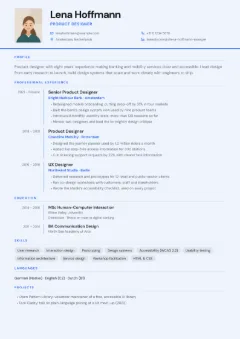
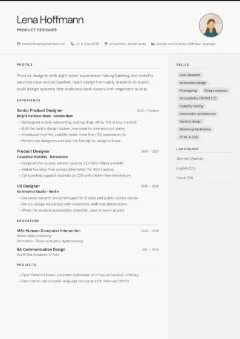
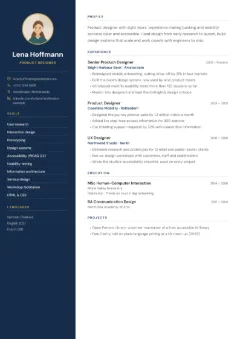
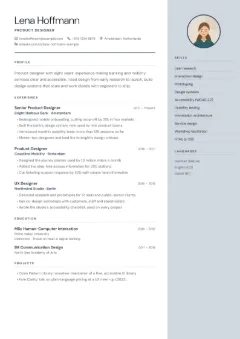
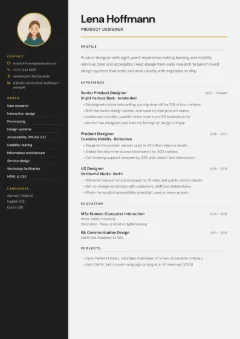
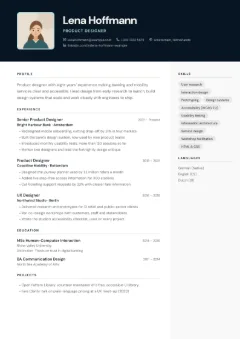
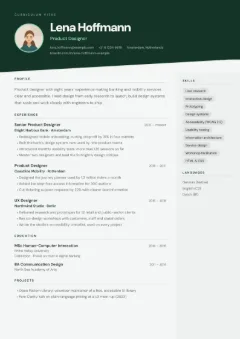
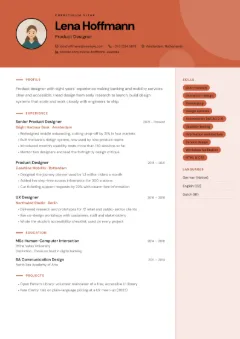
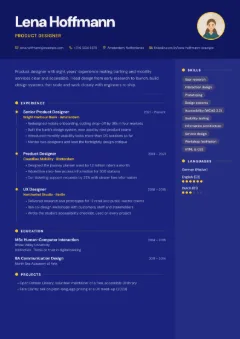
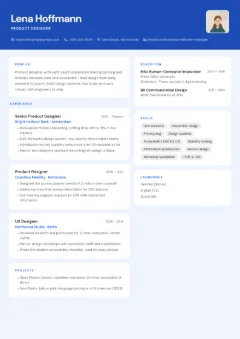
The other 8 layouts have no photo slot, which makes them a natural choice for the UK, Ireland and North America. Whichever you pick, you can switch layouts at any time without retyping anything.
Frequently asked questions
Can an employer ask for a photo?
They can ask, and in Germany, Austria and Switzerland a photo is still part of a typical application. In the UK, Ireland, the US and Canada it’s unusual at the application stage, because a photo reveals characteristics that equality law protects. In the US, the EEOC’s guidance is that a photo needed for identification can be collected once a job offer has been made and accepted.
If a request seems unrelated to the job, it’s reasonable to ask why it’s needed.
Should I smile in my CV photo?
A natural, friendly expression works best, and a slight smile is fine. Avoid a forced grin or a very serious stare, and look straight into the camera.
Can I reuse my LinkedIn photo?
Yes, if it meets the same standard: recent, head and shoulders, a plain background and good light. Using the same photo in both places also helps a recruiter connect your CV with your profile.
I’m in the UK and applying to a German company. Photo or not?
Follow the advert and the company. A German employer recruiting locally may expect one; an international company recruiting in English may not ask at all. If the application form has a photo field, use it. If you’re unsure, a good photo in a single-column layout such as European Classic is a reasonable middle ground.
Does a photo improve my chances?
There’s no reliable rule. Where photos are expected, a missing one can look unusual; where they aren’t, adding one can look out of place. Match the local convention and the advert, and let your experience do the work.
Sources
All checked on 1 October 2026.
- Equality Act 2010 (sections 4 and 39), legislation.gov.uk
- Employers: preventing discrimination, recruitment, GOV.UK
- CV sections, National Careers Service
- How to write a CV, Prospects (2025)
- Employment equality, Workplace Relations Commission (Ireland)
- Prohibited employment policies and practices, US Equal Employment Opportunity Commission
- How to write a good resume, Job Bank, Government of Canada
- Résumé guide and checklist, University of Queensland
- Living and working conditions, EURES country guides (updated 2026)
- Recruter sans discriminer, France Travail
- Allgemeines Gleichbehandlungsgesetz, § 1 and § 6, gesetze-im-internet.de
- How to write an application for a job in Sweden, Øresunddirekt
- Writing a CV, Arbetsförmedlingen (Swedish Public Employment Service)
- How do Danish companies recruit?, Workindenmark (Danish Agency for Labour Market and Recruitment)
- Create your Europass CV, Europass (European Commission)