
The short answer
It depends on where you’re applying:
- UK and Ireland: “CV” is the standard word for the document you send with a job application. Prospects recommends no more than 2 A4 pages.
- US and Canada: the job document is a resume, usually 1 or 2 pages. A CV is a longer record used for academic and research posts, fellowships and grants (MIT Career Advising).
- Australia: both words are used for the same document (University of Queensland).
- Mainland Europe: “CV”, or a local word such as Lebenslauf in German, means the job document, as in the UK.
The names explain the split. Curriculum vitae is Latin for roughly “the course of your life”, while résumé is French for “summary”. In North America they became different documents; in the UK and most of Europe, one word covers both.
Rule of thumb
If a UK employer asks for a resume, send your CV. If a US university asks for a CV, it wants the long academic version, not your 2-page job CV.
Comparison by country
The word is only the start. Length, photos and paper size change too. This table summarises what careers services and public employment services recommend.
| Country | What it’s called | Typical length | Photo | Paper |
|---|---|---|---|---|
| United Kingdom | CV | Up to 2 A4 pages (Prospects) | No, except acting or modelling | A4 |
| Ireland | CV | 1–2 pages (EURES) | Only if the form asks | A4 |
| Germany, Austria, Switzerland | CV, Lebenslauf | Up to 2 pages, often in table form (EURES) | Common, still optional | A4 |
| France | CV | Up to 2 pages (EURES) | Optional | A4 |
| Netherlands | cv | Up to 2 A4 pages (EURES) | Optional | A4 |
| Spain, Italy | CV, currículum, curriculum vitae | Up to 2 A4 pages in Spain (EURES) | Optional in Spain; in Italy only if asked | A4 |
| United States | Resume (a CV is academic) | 1–2 pages (Harvard) | No | US Letter |
| Canada | Resume | Up to 2 pages (Job Bank) | No, not the norm | US Letter |
| Australia | Resume or CV (the same thing) | Usually 2–4 pages (UQ) | No | A4 |
These are conventions, not laws. When an advert or an application portal asks for something specific, follow it. For the photo question country by country, see our guide to photos on CVs; for Europass and national habits across Europe, see the European CV format guide.
The 3 differences that matter most
1. Paper size
The UK, Ireland, mainland Europe and Australia use A4 (210 × 297 mm). The US and Canada use US Letter (8.5 × 11 inches), which is slightly wider and shorter. A PDF in the wrong size still opens, but it prints with odd margins or gets scaled, and it quietly signals that the CV wasn’t written for that market.
2. Personal details
In the UK, the National Careers Service says not to include your age, date of birth, marital status or nationality. North American and Australian guidance also leaves out age, marital status and the photo. Parts of mainland Europe are different: EURES’s guide to Switzerland, for example, lists date of birth and nationality as standard CV details.
3. Spelling and dates
UK English writes organised, analysed, programme, centre; US English writes organized, analyzed, program, center. Dates are the bigger trap: 03/04/2026 is 3 April in the UK and March 4 in the US. On a CV or resume, write months as words, such as “Mar 2024 – Present”, and the problem disappears.
The academic CV exception
In the US, a CV is used to apply for teaching and research posts, fellowships, grants, tenure and promotion (MIT CAPD). Unlike a resume, it has no fixed page limit. MIT suggests 2 to 4 pages early in your career and 4 to 7 pages for someone with more experience, while Harvard’s careers office notes that a CV goes into more depth, covering teaching, research, publications and major presentations.
Typical sections of an academic CV:
- Education, with thesis titles and supervisors where relevant
- Research experience and research interests
- Publications and presentations, in your field’s usual citation style
- Grants, fellowships and awards
- Teaching and mentoring
- Professional memberships and service
UK academic CVs follow the same idea. Prospects notes they can be longer than 2 pages; publications and funding are usually listed in full. Keep the first page focused: current role, education and research interests should be readable at a glance.
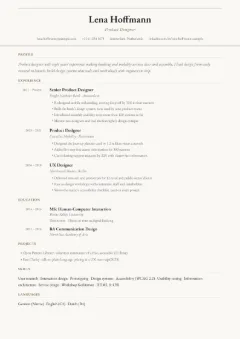
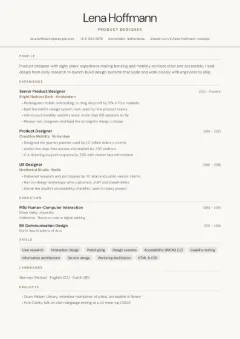
Both layouts above keep everything in one column, in reading order. Academic adds Garamond type and a dates column; Centred Header is a plain choice that suits a UK CV or a US resume equally well.
Turning a US resume into a UK CV
Moving to the UK, or applying to a UK employer from abroad? Work through these 8 changes:
- Switch to A4. In YourCVy, open the Design tab and change the paper size under Format.
- Change to UK spelling. Watch for -ize endings, program and center. You can ask the AI coach to rewrite a section in UK English, then check every change it suggests.
- Turn the summary into a personal statement. 3 to 5 lines on who you are, what you offer and what you want next. See our personal statement examples.
- Remove personal details UK employers don’t expect: photo, date of birth, age, marital status and nationality.
- Write dates as month and year, such as “Sep 2023 – Jun 2026”.
- Explain your grades. Give a US GPA with its scale, such as “GPA 3.7/4.0”, rather than converting it into a UK degree class yourself. If an employer needs an official comparison, UK ENIC, the UK’s official centre for comparing international qualifications, issues Statements of Comparability for a fee.
- Use the space. In the UK, 2 A4 pages is normal, so an experienced career doesn’t need squeezing onto one. Our guide to how long a CV should be has the detail.
- Mention your right to work, if it helps. UK employers must check that applicants are allowed to work in the UK before employing them (GOV.UK), so one line answers a question they’ll ask anyway. In YourCVy, use the optional Work permit field under Extra personal details; it prints as “Right to work: …”.
US resume: Organized a cross-functional program that cut onboarding time by [X%].
UK CV: Organised a cross-functional programme that cut onboarding time by [X%].
Right to work line: Right to work: [visa type], valid until [month and year].
Turning a UK CV into a US resume
Going the other way is mostly about cutting:
- Switch to US Letter and US spelling.
- Aim for 1 or 2 pages. Harvard’s careers office describes a resume as a short synopsis of 1 or 2 pages. Shorten older roles to a single line each.
- Lead with a short summary of 2 to 3 lines instead of a longer personal statement.
- Keep personal details off: no photo, date of birth or marital status. The US EEOC advises employers to avoid questions that would reveal characteristics such as age, sex or national origin.
- Drop the “Curriculum Vitae” label. In YourCVy, Executive, Creative Block, Magazine and Badge Style print it above your name; a plain layout such as Centred Header starts straight with your name.
- Check the file name: “Firstname-Lastname-Resume.pdf” reads naturally to a US recruiter.
Canada follows the same pattern: Job Bank recommends a resume of no more than 2 pages, with no photo and no personal details such as age or marital status. Applying for a US academic post instead? Then you need the long academic CV described above. For the basics of a strong UK CV, start with how to write a CV.
Frequently asked questions
Is a CV longer than a resume?
In the UK and Ireland they’re the same document, usually up to 2 A4 pages. In the US and Canada, yes: a resume is 1 or 2 pages, while an academic CV has no fixed limit and grows with your publications and teaching.
Which word should I use in my file name and on LinkedIn?
Use the word your target country uses: “Firstname-Lastname-CV.pdf” for the UK, Ireland and Europe, and “Firstname-Lastname-Resume.pdf” for the US and Canada. On LinkedIn, recruiters understand both.
What do employers in mainland Europe call it?
Most countries use “CV” or curriculum vitae (currículum in Spanish). German also has Lebenslauf, while Dutch and Swedish simply say “cv”.
If you write your CV in another language, YourCVy can set the section headings in English, German, French, Spanish, Italian, Dutch or Portuguese.
Can I send the same document to UK and US employers?
Start from the same content, but make 2 versions. Paper size, spelling, length and personal details all differ, and the differences are easy to spot. In YourCVy, switch the paper size and layout before each download.
Is “résumé” or “resume” correct?
Both are accepted: “résumé” keeps the French accents, “resume” drops them. Pick one and use it consistently. In the UK you rarely need either word, because the document is a CV.
Sources
All checked on 1 October 2026.
- How to write a CV, Prospects (2025)
- CV sections, National Careers Service
- The resume vs. curriculum vitae (CV), Harvard FAS Office of Career Services (2023)
- Curricula vitae (CVs), MIT Career Advising & Professional Development
- How to write a good resume, Job Bank, Government of Canada
- Résumé guide and checklist, University of Queensland
- Prohibited employment policies and practices, US Equal Employment Opportunity Commission
- Living and working conditions, EURES country guides (updated 2026)
- Check a job applicant’s right to work, GOV.UK
- UK ENIC, the UK national information centre for international qualifications