
Duties vs achievements
A duty describes the job. An achievement shows what changed because you did it. Recruiters can guess your duties from your job title, so every bullet should add something the title doesn’t. This guide expands the work experience step of our guide on how to write a CV.
| Duty | Achievement |
|---|---|
| Responsible for stock control | Cut out-of-stock lines by [X%] by introducing a weekly stock check with suppliers |
| Dealt with customer complaints | Resolved [N] complaints a week and raised the store’s customer satisfaction score from [X] to [Y] |
| In charge of the staff rota | Planned rotas for [N] staff, cutting overtime costs by [£X] a month |
The CAR method
CAR gives every bullet the same shape:
- Challenge (some guides say context): the problem, goal or situation you faced.
- Action: what you did, starting with a strong verb.
- Result: what changed, ideally with a number for time, money, volume, quality or customer feedback.
On a CV the challenge is often implied, so most bullets read verb + what you did + result. Leading with the result works too, and is quicker to scan.
Challenge: customers waited too long at the tills on Saturdays.
Action: rearranged till cover around hourly footfall figures.
Result: Saturday queues [X] minutes shorter.
CV bullet: Cut Saturday queue times by [X] minutes by rearranging till cover around hourly footfall data.
CAR is a compact cousin of the STAR method (Situation, Task, Action, Result), which the National Careers Service recommends for interviews, application forms and CVs. Use CAR for the one-line bullet and keep the fuller STAR story for the interview.
Before and after: 8 examples across sectors
Each “after” uses placeholders in square brackets. Replace them with your real figures. If you don’t have a number, a concrete outcome still beats a duty: “Rewrote the returns guide that the area manager then shared with every store in the region.”
Retail
Before: Worked on the tills and helped customers.
After: Served around [N] customers a shift and trained [N] new starters on refunds, reducing till errors reported by the store manager from [X] to [Y] a month.
Nursing and care
Before: Did patient observations and handovers.
After: Introduced a structured bedside handover on a [N]-bed surgical ward, reducing missed observations in monthly audits from [X] to [Y].
Administration
Before: Handled office supplies and the post.
After: Moved stationery ordering to a single supplier account, saving [£X] a year and cutting ordering time from [X] hours to [Y] a week.
Software development
Before: Worked on the payments API.
After: Rebuilt the payments API’s retry logic in [language], reducing failed card payments by [X%] and related support tickets by [N] a month.
Sales
Before: Called potential customers.
After: Generated [£X] in new annual revenue by targeting [sector] firms with a [N]-step outreach sequence; [X%] of first meetings led to a proposal.
Teaching
Before: Taught Year 10 maths.
After: Raised the share of a Year 10 maths set reaching grade [N] or above from [X%] to [Y%] with weekly low-stakes quizzes and targeted catch-up groups.
Hospitality
Before: Worked on reception.
After: Handled [N] guest enquiries a day by phone, email and at the desk, and lifted the hotel’s average review score from [X] to [Y] by introducing a pre-arrival email.
Finance
Before: Did the month-end reconciliations.
After: Shortened the month-end close from [X] to [Y] working days by automating bank reconciliations in Excel with Power Query.
Where to find your numbers
You probably have more figures than you think. Look for:
- Volume: customers served, calls, patients, orders, students, tickets or events, per day, week or year.
- Time: hours or days saved, deadlines met, turnaround times.
- Money: sales, savings, budgets managed, revenue generated, costs avoided.
- Quality: error rates, audit and inspection results, complaints, review scores.
- People: team size, people trained, colleagues you mentored.
- Scale: sites, stores, wards, countries or users.
Good places to look: appraisals and performance reviews, monthly reports and dashboards, sales or CRM figures, rotas, audit results, customer feedback and old emails that thanked your team for something specific. If a figure is confidential, give a percentage or a ratio instead of the amount.
Estimate, never invent
An estimate is fine if you can defend it: use a round figure (“around 40 calls a day”) and be ready to explain how you got it. Never make a number up. Interviewers ask, and references can contradict you.
120 action verbs for your CV (UK English)
Pick the verb that says exactly what you did. Vary them, but don’t reach for an unusual word when a plain one is more accurate: “led” is fine. Every verb here uses UK spelling, so watch for analysed, organised and prioritised if your spellchecker is set to US English.
Leading and managing
- Led
- Managed
- Directed
- Supervised
- Coached
- Mentored
- Delegated
- Recruited
- Chaired
- Headed
- Motivated
- Oversaw
- Steered
- Championed
- Mobilised
Delivering and achieving
- Delivered
- Achieved
- Completed
- Launched
- Exceeded
- Secured
- Won
- Generated
- Produced
- Introduced
- Established
- Implemented
- Rolled out
- Accomplished
- Executed
Improving and changing
- Improved
- Streamlined
- Reduced
- Cut
- Increased
- Boosted
- Accelerated
- Simplified
- Modernised
- Transformed
- Restructured
- Revamped
- Optimised
- Standardised
- Upgraded
Analysing and researching
- Analysed
- Assessed
- Evaluated
- Investigated
- Researched
- Audited
- Forecast
- Identified
- Measured
- Modelled
- Reviewed
- Surveyed
- Tested
- Diagnosed
- Mapped
Communicating and influencing
- Presented
- Negotiated
- Persuaded
- Wrote
- Edited
- Briefed
- Advised
- Consulted
- Promoted
- Pitched
- Published
- Convinced
- Liaised
- Facilitated
- Represented
Supporting customers and people
- Resolved
- Supported
- Mediated
- Guided
- Counselled
- Cared for
- Advocated
- Welcomed
- Served
- Responded
- Trained
- Onboarded
- Retained
- Reassured
- Enabled
Organising and planning
- Organised
- Planned
- Coordinated
- Scheduled
- Prioritised
- Arranged
- Budgeted
- Allocated
- Prepared
- Catalogued
- Processed
- Maintained
- Administered
- Tracked
- Monitored
Technical and creative
- Built
- Designed
- Developed
- Engineered
- Programmed
- Automated
- Configured
- Integrated
- Migrated
- Deployed
- Debugged
- Created
- Illustrated
- Prototyped
- Visualised
Words to cut
Some phrases take up space without telling the reader anything. The same clichés weaken a personal statement, so check yours against our personal statement examples too.
| Instead of | Why it’s weak | Try |
|---|---|---|
| Responsible for… | Describes a duty, not what you did | Start with the verb: “Managed”, “Ran”, “Led” |
| Duties included… | Reads like a job description | Two or three achievements |
| Helped with… | Hides your part in the work | Say what you did: “Drafted”, “Prepared”, “Analysed” |
| Hard-working | Everyone says it; nobody can check it | A result you delivered under pressure |
| Team player | Vague | “Worked with [team] to…” plus the outcome |
| Excellent communication skills | A claim without proof | “Presented [topic] to [N] colleagues” |
| Results-driven | A label, not a result | Put the result in the bullet |
| Various, a number of | Vague | The number: “[N] clients” |
| Successfully | Adds nothing; the result shows the success | Delete it |
| Utilised | A longer way to say “used” | Used |
How many bullets per role?
- Recent roles (your last two or three): 3 to 6 bullets.
- Older roles: 1 or 2 bullets.
- Roles that ended more than 15 years ago: one line, or a combined “Earlier career” entry.
Keep each bullet to one or two lines and put the most relevant one first, because readers skim from the top. Where it’s true, use the exact skills from the job advert inside your bullets: it helps recruiters and applicant tracking systems find them.
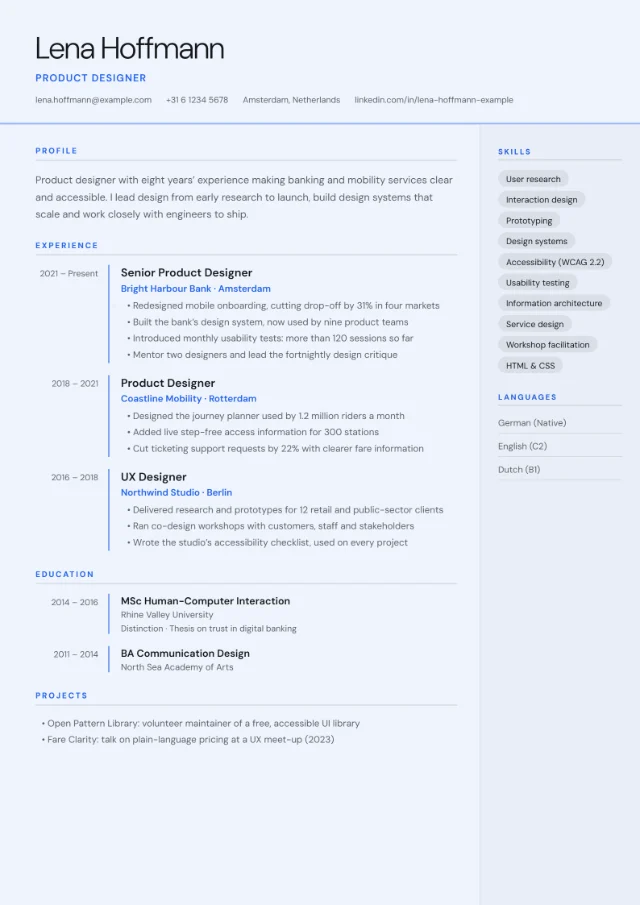
Let the AI coach help with yours
Upload your CV to YourCVy, open the AI coach and choose Stronger bullet points, or paste one bullet with a prompt like this:
Rewrite this bullet with the CAR method in under two lines, in UK English. Start with an action verb. If it needs a number I haven’t given you, use a placeholder like [X%] instead of guessing.
The coach is told never to invent employers, numbers or qualifications, so it leaves placeholders for you to fill in. AI can still make mistakes: check every line before you use it, and make sure you could talk about it at interview. There are more prompts in our guide on how to improve your CV with AI.
Frequently asked questions
Should I use STAR or CAR?
Both work. STAR (Situation, Task, Action, Result) is the method the National Careers Service describes for interviews and applications. CAR folds the situation and task into one “challenge”, which suits a one-line CV bullet. Write your bullets with CAR, then prepare a STAR story for each so you can expand on it at interview.
Should bullet points be in the past or present tense?
Use the present tense for your current role (“Manage a team of [N]”) and the past tense for earlier roles (“Managed”). Keep the tense consistent within each role.
Do CV bullet points need full stops?
Either style is fine. Choose one, with or without full stops, and use it on every bullet.
Should I write “I” in my bullet points?
No. Start each bullet with the verb, in implied first person: “Reduced waiting times by [X%]”, not “I reduced waiting times”. It saves space and reads faster.