
The short answer
- Use Europass when the advert asks for it. Some EU secondment calls and many Austrian employers do.
- Otherwise, send a clear CV of up to 2 pages, most recent experience first. The EURES guides that give a length all set 2 pages as the limit.
- Adjust the details to the country: photo, date of birth and nationality are normal in some countries and best left out in others.
- List languages with CEFR levels, such as “German (C1)”. It’s the scale Europass uses.
What Europass is
Europass is a free set of online tools from the European Commission for managing your learning and career. It includes CV and cover letter editors, a profile you can build several CVs from, and a document library. It works in 31 languages.
Europass describes its CV as one of the best-known CV formats in Europe, and some recruiters ask for it by name:
- EU secondments. The European Commission’s April 2026 call for seconded national experts asks candidates to write their CV in English, French or German using the European CV form from the Europass site (Commission letter, April 2026). EPSO competitions are different: you fill in a structured CV in EPSO’s online candidate portal (EU Careers).
- Austria. EURES says the Europass CV is required by many companies.
- Germany and beyond. The EURES guide for Germany recommends the Europass format, and the guides for Italy, Spain, Finland and Sweden point to it as an option. The Netherlands is the exception: EURES says Europass is not yet widely known among Dutch employers.
If an advert names Europass, use the official editor at europass.europa.eu rather than imitating the format elsewhere.
Europass or a modern CV?
| Aspect | Europass CV | Modern 2-page CV |
|---|---|---|
| Best for | Adverts that ask for it, such as Commission secondments, and many Austrian employers | Most private-sector jobs across Europe and the UK |
| Strengths | Free, familiar to many recruiters, 31 languages, a language section built on CEFR levels | You control the order, length and design, so your strongest points come first |
| Drawbacks | A fixed structure and a limited choice of designs; filling every field makes it long | Not the right document when an advert asks for Europass |
| Length | As short as you make it; Europass advises focusing on facts and main points | Up to 2 A4 pages for most people |
Our advice: use Europass when you’re asked to, and a well-structured modern CV everywhere else; our guide on how to write a CV covers each section in order.
What employers expect, by country
The summaries below come from EURES, the EU’s job-mobility portal, plus national careers services where EURES is silent. Treat them as conventions, not rules: the advert always comes first.
| Country | Length | Photo | Also expected |
|---|---|---|---|
| Germany | Up to 2 pages, in table form | Usually included | Signed and dated; certificates attached |
| Austria | 1–2 A4 pages (1 is better) | Usually included | Written in German unless stated; Europass often requested; signature recommended (AMS) |
| Switzerland | Up to 2 A4 pages | Usually included | Date of birth and nationality; diplomas and employment certificates |
| France | Up to 2 pages | Optional | French equivalents of your qualifications; language levels |
| Belgium | Not specified | Only if required or asked | No private details (age, nationality, marital status, gender); CEFR language levels |
| Netherlands | Up to 2 A4 pages | Optional | Short and factual; a letter in Dutch is appreciated |
| Spain | Up to 2 A4 pages | Optional | Written in Spanish |
| Portugal | 1–2 pages | Often appreciated | Town and country rather than a full address |
| Italy | Not specified | Only if asked | A data-processing consent line |
| Sweden | 1–2 pages | Common, optional | Date of birth; references on request |
| Finland | Up to 2 A4 pages | Optional, quite common | 2 referees, or a note that references are available |
| UK | Up to 2 A4 pages | No | No date of birth, marital status or nationality |
| Ireland | 1–2 pages | Only if asked | Language skills, especially if English isn’t your first language |
Germany, Austria and Switzerland
The EURES guide to Germany describes a Lebenslauf in table form (dates in one column, details in the other), no longer than 2 pages and in reverse chronological order. It says a friendly application photo with a neutral background is still part of a German application, and advises that the CV is signed and dated. A full application usually adds a cover letter and copies of certificates and references.
For Austria, EURES recommends 1 or 2 A4 pages, ideally 1, written in German unless the advert says otherwise. In Switzerland, the CV usually includes your date of birth and nationality, and great weight is placed on diplomas and certificates of employment, so describe your career progression and avoid unexplained gaps.
No law requires a photo; our photo guide covers the choice and the German equality law behind it.
France
The EURES guide to France asks for no more than 2 pages in a fairly fixed order: civil status (first name, SURNAME, contact details with an international phone code), the job you’re applying for, work experience, then education with the French equivalent of each qualification. State your mother tongue and your reading, writing and speaking level in French. An interests section usually closes the CV; a photo is optional.
Netherlands
Dutch CVs are short and factual. EURES recommends a maximum of 2 A4 pages, adapted to each position, in this order: personal details, education, work experience (most recent first), then hobbies and voluntary work. You don’t need to attach certificates or references; bring them to the interview. Application letters in Dutch are appreciated unless the advert says otherwise. Use the standard Dutch format rather than Europass, which EURES says is not yet widely known among Dutch employers.
Spain and Portugal
For Spain, EURES recommends a clear, concise CV of up to 2 A4 pages, written in Spanish, with simple sentences and few abbreviations. A photo isn’t compulsory but may help for some jobs.
In Portugal, a CV is usually 1 or 2 pages in reverse chronological order. Give your town and country rather than your full address. A photo is often appreciated, and if you don’t speak Portuguese you can write your CV in English. Copies of certificates are only needed once you’re hired.
Italy: the data-processing consent line
The EURES guide to Italy asks for a CV tailored to the job, with a cover or motivation letter, and no photo unless one is requested. It also tells applicants to include permission for their personal data to be processed under data protection law.
That’s why many Italian CVs end with a one-line authorisation citing Italy’s privacy code and the GDPR. Strictly, it isn’t required for a CV you send yourself: since 2018, article 111-bis of the privacy code says no consent is needed to process a spontaneously submitted CV for recruitment (Normattiva). It remains a strong convention, and Randstad Italia warns that leaving it out can complicate the selection process.
Autorizzo il trattamento dei dati personali contenuti nel mio curriculum vitae ai sensi del D.Lgs. 196/2003 e del Regolamento (UE) 2016/679 (GDPR).
In English: I authorise the processing of the personal data in my CV under Legislative Decree 196/2003 and Regulation (EU) 2016/679 (GDPR).
Put it at the very end of the CV. In YourCVy, add it as an extra section with a short title such as “Privacy”; in European Classic, extra sections come last.
Nordic countries
For Sweden, EURES recommends 1 to 2 pages in reverse chronological order, with personal details that include your date of birth and possibly your nationality. References can be provided on request. Photos are common but not required (Øresunddirekt, Arbetsförmedlingen).
For Finland, EURES recommends no more than 2 A4 pages, most recent first, with 2 referees or a note that references are available. A photo is optional but quite common. For Denmark, EURES says most applications are made online, with a CV and a motivation letter adapted to the position; Workindenmark adds that Danish companies notice the photo and profile text first, so include a professional one. For Norway, EURES notes that some employers are moving away from cover letters because AI has made applications more uniform; where a CV and a cover letter are both required, tailor each to the job.
UK and Ireland
The UK’s National Careers Service says not to include your age, date of birth, marital status or nationality. EURES Ireland suggests 1 to 2 pages, a photo only if the form asks, and a clear language section if English isn’t your first language. If you’re moving between the UK and North America, see CV vs resume.
Languages: use CEFR levels
The Common European Framework of Reference for Languages (CEFR), from the Council of Europe, describes language ability on 6 levels in 3 groups. Europass uses the same levels in its self-assessment grid, so recruiters who know Europass will recognise them.
| Level | Group | What it means |
|---|---|---|
| A1 | Basic user | You understand and use familiar everyday expressions and very simple phrases, and can introduce yourself. |
| A2 | Basic user | You handle simple, routine exchanges about familiar things such as your work, shopping or your local area. |
| B1 | Independent user | You follow the main points on familiar topics, cope with most travel situations and write simple connected text. |
| B2 | Independent user | You understand the main ideas of complex texts, including technical discussions in your field, and talk with native speakers fluently enough that neither side struggles. |
| C1 | Proficient user | You use the language flexibly at work, in study and socially, understand implied meaning and write well-structured, detailed text. |
| C2 | Proficient user | You understand virtually everything you hear or read and express yourself precisely, with fine shades of meaning. |
How to write them on your CV:
- Put the level in brackets after the language: German (C1), Dutch (B1).
- For your first language, write English (Native) or “mother tongue”, not C2.
- If your skills differ, say so: Spanish (B2 spoken, B1 written). The Europass grid splits levels into listening, reading, spoken interaction, spoken production and writing.
- Add a certificate if you have one: French (B2, [certificate name], [year]).
- Only claim a level you could show in an interview.
In YourCVy, the Infographic layout turns CEFR levels into language-level dots.
Personal details: what to include, and where
| Detail | UK and Ireland | Germany, Austria, Switzerland | Elsewhere in Europe |
|---|---|---|---|
| Date of birth | Leave it out | Optional; standard in the Swiss guidance | Varies: listed for Sweden, optional in France, not needed in Belgium |
| Nationality | Leave it out | Optional; standard in the Swiss guidance | Optional; “possibly” for Sweden, optional in France for EEA nationals |
| Marital status | Leave it out | Optional; leave it out unless asked | Optional in France, not needed in Belgium; leave it out unless asked |
| Photo | Leave it out | Usually included | Varies; see our photo guide |
| Work permit | Add one line if you need a permit or already hold the right to work, for example “Right to work: [permit type], valid until [month and year]”. | ||
In YourCVy, these live under Extra personal details in the Content tab: date of birth, nationality, work permit and availability. Use them where they’re expected, such as Switzerland, and leave them empty for UK and Irish applications.
The European Classic layout
We designed European Classic for applications in Germany, Austria, Switzerland and much of continental Europe. It brings together the conventions above:
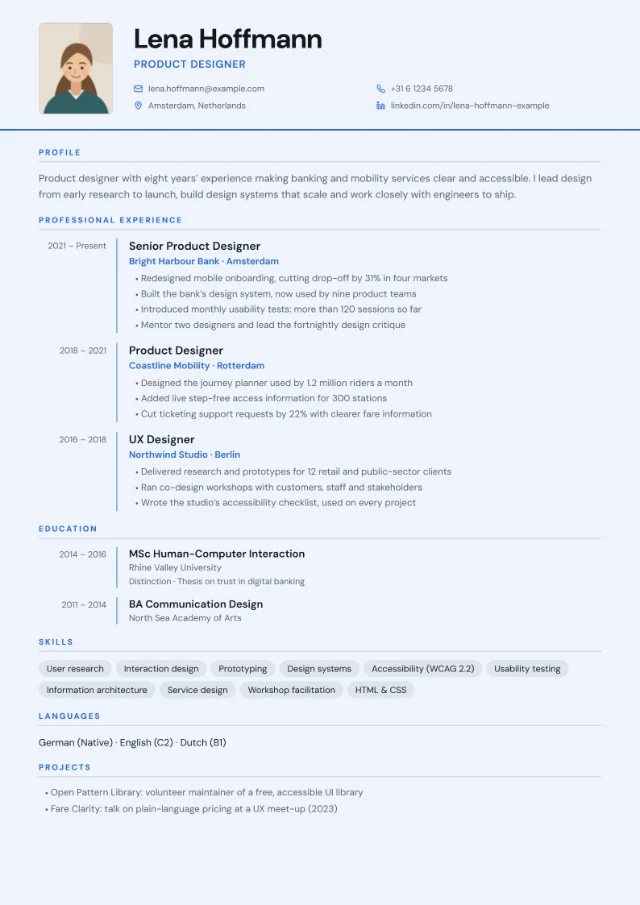
- A photo slot at the top left, which you can leave empty
- Contact details plus optional date of birth, nationality, work permit and availability
- A dates column for experience and education, like a German Lebenslauf
- A single column with skills and language skills, the safest structure for online job portals
- Section headings in 7 languages
- A4 by default, with US Letter available
Want the same content without a photo for a UK application? Remove the photo, or switch to a plain one-column layout such as Centred Header, without retyping anything. For other layouts with a photo slot, see our CV templates with a photo.
Frequently asked questions
Do I need a Europass CV for jobs in Germany?
Only if the advert asks for it. EURES’s Germany guide does suggest Europass, but the CV it describes in detail is a signed and dated Lebenslauf in table form, up to 2 pages. Send that unless Europass is requested.
Should I write my CV in English or the local language?
Use the language of the advert. If a job is advertised in English, an English CV is fine. If it’s advertised in the local language, write in that language if you can work in it.
Do I need to sign my CV?
In Germany, EURES still advises you to sign and date your CV. If you apply by email, it suggests sending one PDF that combines your cover letter, CV, certificates, references and photo, no larger than 2 MB. Austria’s public employment service, AMS, also recommends signing, and says a scanned signature in the PDF works for digital applications. For the other countries in this guide, the official guidance doesn’t mention a signature.
Can I use one CV for several European countries?
Yes. Keep one master version and adapt a copy for each country: photo, personal details, language and length. In YourCVy you can switch layout, heading language and paper size without retyping.
Is the Italian consent line needed outside Italy?
No. It’s an Italian convention. For other countries, leave it off unless an employer specifically asks for consent.
Sources
All checked in October 2026.
- About Europass and Create your Europass CV, European Commission
- Call for seconded national experts, European Commission letter to Permanent Representations, April 2026 (copy hosted by the Slovenian foreign ministry)
- How to apply for a competition, EU Careers (EPSO)
- Global scale: common reference levels (CEFR table 1), Council of Europe
- CEFR self-assessment grid, Europass
- Living and working conditions, EURES country guides for 14 countries (updated 2026)
- D.Lgs. 196/2003, article 111-bis, Normattiva
- Autorizzazione al trattamento dei dati personali nel CV, Randstad Italia
- Lebenslauf unterschreiben, AMS (Arbeitsmarktservice Österreich)
- How to write an application for a job in Sweden, Øresunddirekt
- Writing a CV, Arbetsförmedlingen (Swedish Public Employment Service)
- How do Danish companies recruit?, Workindenmark (Danish Agency for Labour Market and Recruitment)
- CV sections, National Careers Service
- How to write a CV, Prospects (2025)