
The short answer
Two A4 pages for most people. UCAS advises “no longer than two sides of A4”, and the University of Sheffield’s careers service calls two sides “the norm” for placement and graduate roles.
- One page for school leavers, part-time jobs and students with little experience so far.
- Two pages for graduates with placements or projects, and for almost everyone with a few years’ experience.
- Longer only for academic and research CVs, where publications, grants and teaching need the space.
Relevance beats length
A tight page and a half beats two full pages of padding. Put your strongest, most recent evidence on page one, because that’s the page every reader sees.
For what belongs on those pages, section by section, see our guide on how to write a CV.
CV length by career stage
Use this as a starting point, not a rule. If an advert sets a page limit, that limit wins.
| Career stage | Pages | What earns the space |
|---|---|---|
| School leaver | 1 | Qualifications, part-time work, volunteering, skills |
| Student or recent graduate | 1 to 2 | Degree, projects, placements, part-time work |
| 2 to 10 years’ experience | 2 | Recent roles and results; one line per qualification |
| 10+ years’ experience | 2 | The last 10 to 15 years in detail; one line for each earlier role |
| Career changer or returner | 2 | Transferable results and recent training near the top |
| Senior manager or director | 2, occasionally 3 | Scope (team size, budget, markets) and outcomes |
| Academic or researcher | No fixed limit | Publications, grants, teaching, conferences |
Graduates: two sides is the norm for graduate and placement roles, but one full page is fine if all you have so far is your degree and a part-time job. Go to two when you have placements, projects, a year abroad or society roles with results worth describing, rather than stretching thin material to fill the space.
Senior roles: a third page is acceptable when it holds board roles or publications that matter for the job, not older duties. Our executive CV template page has more on senior CVs.
Academic CVs follow different rules. jobs.ac.uk says that if no limit is given, an academic CV “should be as long as it needs to be”, but you should stick to any page limit in the advert.
CV length by country
Most of Europe agrees on two pages. These are the conventions published by national careers bodies and by EURES, the European Commission’s job mobility portal:
| Country | Usual length | Source |
|---|---|---|
| UK | Up to two A4 pages; one for most part-time jobs | UCAS, University of Sheffield |
| Ireland | One to two pages | EURES Ireland |
| Germany | No more than two pages, in table form, most recent first | EURES Germany |
| France | No more than two pages | EURES France |
| Netherlands | Normally a maximum of two A4 pages | EURES Netherlands |
| Spain | Best kept to two A4 pages | EURES Spain |
| United States | A resume of one page, or two if you have a lot of relevant experience; two at most for federal jobs | MIT CAPD, OPM |
Two details for applications across the Atlantic. Since 27 September 2025, most US federal jobs advertised on USAJOBS accept resumes of no more than two pages, under rules from the Office of Personnel Management. And US Letter paper is 17.6 mm shorter than A4, so a CV that fits on two A4 pages can spill onto a third when you switch. Read CV vs resume for the other differences.
10 ways to cut a CV to two pages
- Summarise old roles. Cut jobs from more than 15 years ago to one line each, or group them as “Earlier career”.
- Cap your bullets: 3 to 6 for recent roles, 1 or 2 for older ones.
- Merge repeats. If two bullets prove the same skill, keep the one with the better result.
- Delete obvious duties. “Answered customer emails” adds nothing under a customer service job title. Keep the results.
- Shorten your personal statement to three to five lines.
- Shrink education to one line per qualification once you have a few years’ experience, and drop school grades.
- Cut generic skills. Keep the ones the advert asks for and remove claims like “good communicator” that your bullets should prove.
- Drop “References available on request”. Employers ask for referees when they need them.
- Remove personal details you don’t need. For UK and Irish jobs a town is enough: no full address, date of birth or photo.
- Keep interests only if they’re relevant, and fit them on one line.
Before: three older jobs with four bullets each, filling a third of page two.
After: Earlier career: sales and customer service roles at [Employer] and [Employer], 2006–2012.
Use layout, not tiny text
Shrinking the font is the worst way to save space. For a CV typed in Arial, Times New Roman or Calibri, the National Careers Service suggests “size 11 or bigger”, and UCAS “between size 10-12”. Fonts look bigger or smaller at the same point size, so check by eye too: print one page at 100% and make sure it reads easily without leaning in. Keep comfortable margins and save space with structure instead:
- tighten the spacing between sections, not the text itself;
- put short lists such as skills and languages on one line, or in a narrow side column;
- choose a layout that uses the width of the page well.
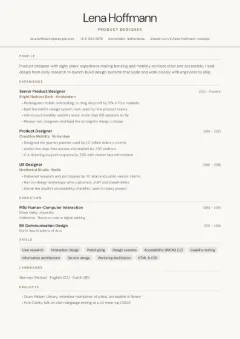
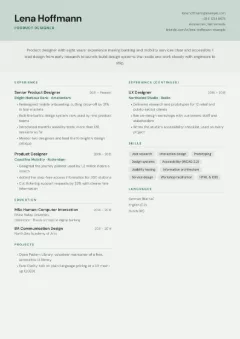
In YourCVy, the Format settings in the Design tab let you set Spacing to Compact, Normal or Relaxed and Text size from 90% to 115%, and the preview marks where each page ends, so you can see at once whether a change tips your CV onto another page. If you run over, use Compact spacing and the cuts above rather than lowering the text size. A single-column layout is still the safest choice for online job portals, as our ATS-friendly CV guide explains; you can compare all 18 in our CV templates.
Does page two need to be full?
No. A page and a half is fine. Aim to fill at least a third of page two, though: a few lines alone on the last page can look like an accident.
- Only a few lines over? Tighten page one with the cuts above until everything fits on one page.
- Half a page over? Let it run, and move a whole section, such as education or languages, onto page two so the break falls between sections.
Either way, keep the essentials on page one: your contact details, personal statement and most recent role.
Check the length the employer will see
Count pages in the file you’ll actually send, not in your editor. Export the PDF, open it and check the page count on the right paper size: A4 for the UK and Europe, US Letter for North America. Then scroll through once at normal size to make sure no heading is stranded at the bottom of a page with its content on the next.
Frequently asked questions
Is a 3-page CV too long?
For most jobs in the UK and Europe, yes: two pages is the norm. The exceptions are academic CVs and some senior roles with board positions or publications that matter for the job. If you’re on page three for any other reason, work through the 10 cuts above.
Is a one-page CV better?
Only when you don’t have much to say yet. Experienced candidates who squeeze onto one page usually cut the results that win interviews. Two well-used pages are better than one crowded one.
Do I have to include every job I’ve had?
No. A CV is a selection, not a complete record. Give recent and relevant roles in detail and summarise or leave out the rest. For the last few years, though, don’t leave an unexplained gap: a one-line entry is enough.
Can I use a smaller font to fit two pages?
Only a little, and only as a last resort. Small text is tiring to read on screen and on paper, and recruiters skim. Cut words, tighten the spacing or change the layout first, then print a page to check it still reads easily.
Does a cover letter count towards the length?
No. UCAS’s two-side guideline is “not including your cover letter”. The letter itself should fit on one page, as EURES advises for Germany, France and the Netherlands.