
The structure at a glance
Recruiters skim a CV before they read it, so put the evidence that you can do the job near the top. Most UK and European employers expect these sections, in roughly this order:
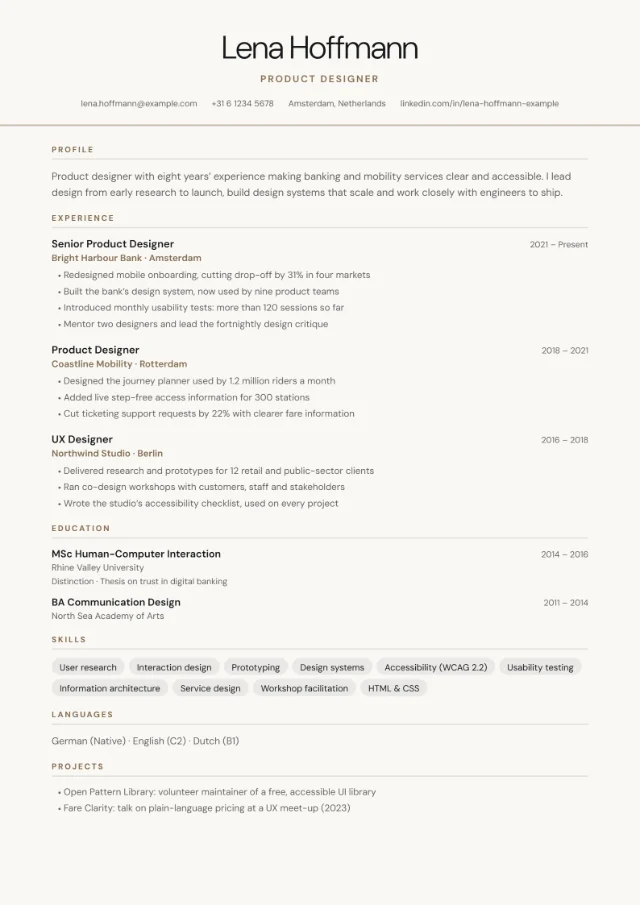
- Name and contact details
- Personal statement: three to five lines on who you are and what you offer
- Work experience, most recent first
- Education and qualifications
- Skills
- Languages, with a level for each
- Optional sections such as projects, volunteering or certifications
Early in your career? Swap 3 and 4. The National Careers Service suggests putting education straight after your introduction if you don’t have much work experience yet, and your work history first if you do.
Contact details
Your name is the heading of the page. There’s no need to write “Curriculum Vitae” above it. Underneath, add:
- a mobile number;
- a professional email address, ideally your name rather than a nickname;
- your town or city, plus the country if you’re applying abroad (no full postal address);
- a LinkedIn profile or portfolio link, if it’s up to date.
Lena Hoffmann
Product Designer · Amsterdam, Netherlands
+31 6 1234 5678 · lena.hoffmann@example.com · linkedin.com/in/lena-hoffmann-example
What to leave out in the UK and Ireland
The National Careers Service is direct: don’t include your age, date of birth, marital status or nationality. Leave off a photo too: the University of Sheffield’s careers service says “Don’t include a photo of yourself for a UK CV”. Age, marriage and civil partnership, and race (which includes nationality) are protected characteristics under section 4 of the Equality Act 2010, so recruiters prefer not to see them. Ireland’s Employment Equality Acts cover nine similar grounds.
Leave out your health too: under section 60 of the Act, employers generally must not ask about it before offering you work. If a recruiter might wonder whether you need a visa, one true line such as “Right to work in the UK: [your status]” answers the question early. Employers must check your right to work before hiring you anyway.
Applying in Germany, France or Italy? See UK vs mainland Europe below.
Personal statement
Also called a profile or summary, this is the short paragraph under your name. The National Careers Service describes it as “a few short lines that sum up who you are and what you hope to do”. Three to five lines is plenty. Use a simple formula:
- Who you are: your role or field and your level of experience.
- What you offer: one or two strengths, each with proof.
- What you want next: the kind of role you’re applying for.
Customer service team leader with [N] years’ experience in retail and contact centres. Cut average complaint resolution time by [X%] with a simple escalation process and coach every new starter through their first month. Looking for a first operations management role in [sector].
Write in implied first person: leave out “I”, and never describe yourself as “he” or “she”. Skip labels a recruiter can’t check, such as “hard-working team player”. For graduates, career changers and managers, see our personal statement examples.
Work experience
List your jobs in reverse-chronological order, most recent first. For each role give:
- job title, employer and town;
- start and end dates as month and year, such as “Mar 2022 – Present”, in one format throughout;
- 3 to 6 bullet points for recent roles and 1 or 2 for older ones.
Cover the last 10 to 15 years in detail. Earlier jobs can share one line, such as “Earlier roles in retail management, 2005–2011”, and temporary or freelance contracts can share one heading.
Show achievements, not duties
Your job title already tells the reader what you were responsible for. Your bullets should show what changed because you did the job. The CAR method helps: name the challenge, the action you took and the result. Start with a strong verb and add a number where you have one.
Before: Responsible for the company’s social media accounts.
After: Grew LinkedIn followers by [X%] in [N] months by planning a weekly content calendar with the sales team.
Only use figures you can explain at interview. Our guide to CV action verbs has 120 verbs and before-and-after bullets for eight sectors.
Education and qualifications
List qualifications most recent first: the qualification, the institution, the dates and, where it helps, your result. Recent graduates can add a line on a dissertation, modules or a placement. With a few years’ experience, one line per qualification is enough.
BSc (Hons) Economics, 2:1 · University of [City] · 2020–2023
Dissertation on [topic]; modules in econometrics and public finance
- UK degree classes. Most UK universities award a First, an upper second (2:1), a lower second (2:2) or a Third, as UCAS explains. Include yours if you graduated recently.
- School qualifications. Summarise them in one line, such as “[N] GCSEs including English and Maths”, and drop them once you have a degree or several years’ experience.
- Qualifications from abroad. Keep the original name and add an English description, for example “Licenciatura en Derecho (Bachelor’s degree in Law)”. UK ENIC sells a Statement of Comparability that shows how it compares with UK qualifications.
- Courses and certifications can go here, or in a section of their own if you have several.
Skills and languages
A short skills section helps recruiters, and the applicant tracking software some employers use, match you to the advert. Keep it to the 6 to 10 skills that matter for this job and be specific: “Excel (pivot tables, XLOOKUP)” says more than “IT skills”. Then prove the most important ones in your experience bullets.
Skip skill bars and star ratings. Nobody can tell what “four stars in Excel” means, and a graphic carries no text that software can read.
Languages: use CEFR levels
Across Europe, language skills are described with the Council of Europe’s Common European Framework of Reference for Languages (CEFR), and Europass uses the same six levels. Write the language and level, such as “German (B2)”, and call your first language “native”. Add a certificate if you have one: “Spanish (B2, DELE B2)”.
| Level | Group | In plain English |
|---|---|---|
| A1 | Basic user | You can use familiar everyday expressions and very simple phrases. |
| A2 | Basic user | You can handle simple, routine exchanges about familiar things. |
| B1 | Independent user | You can handle most situations when travelling and describe your experiences and plans. |
| B2 | Independent user | You can follow the main ideas of complex texts, including technical ones in your field, and talk with native speakers without strain. |
| C1 | Proficient user | You use the language fluently and flexibly at work and in study. |
| C2 | Proficient user | You understand virtually everything and express yourself precisely. |
Optional sections
Add extra sections only when they strengthen your application:
- Projects for graduates, career changers and technical roles: one line each.
- Volunteering, written like a job, with a result.
- Certifications: professional qualifications and licences the advert asks for.
- Publications for research, journalism and policy roles.
- Interests, only if they show something relevant, such as “Treasurer of a [N]-member running club”. The National Careers Service suggests interests “that show some of the skills you have”.
You don’t need a references section. The National Careers Service suggests “references are available on request” instead of names and contact details, and the University of Sheffield’s careers service says you don’t need to give referees at this stage. If space is tight, drop the line altogether.
Length, layout and file type
- Length. Two A4 pages suit most people: UCAS says “no longer than two sides of A4”. One page is fine for school leavers and part-time jobs, and academic CVs can be longer. Our guide to how long a CV should be covers every career stage.
- Fonts. One clear font for body text. The National Careers Service suggests Arial, Times New Roman or Calibri “in size 11 or bigger”. Fonts look bigger or smaller at the same size, so print a page and check it reads easily.
- Layout. Clear headings and white space. For online job portals a simple single-column layout is the safest choice; keep design-led layouts for CVs you send to a person. Our ATS-friendly CV guide explains why.
- File type. Send a PDF unless the employer or agency asks for Word. Check the PDF has real text: if you can’t select a sentence with your cursor, it’s an image and software can’t read it.
- File name. Firstname-Lastname-CV.pdf, not CV_final_v3.pdf.
- Paper size. A4 for the UK and Europe; US Letter only for the US and Canada.
UK vs mainland Europe
The core structure travels well, but conventions on length, photos and personal details differ. This table summarises advice from UK careers services and from EURES, the European Commission’s job mobility portal.
| Country | Length | Photo | Also worth knowing |
|---|---|---|---|
| UK | Up to two A4 pages | Leave it off | No age, date of birth, marital status or nationality |
| Ireland | One to two pages | Only if the employer asks | Close to UK conventions |
| Germany | No more than two pages, in table form, most recent first | Usually included | EURES advises signing and dating the CV and enclosing copies of certificates |
| France | No more than two pages | EURES sets no rule; follow the advert | Marital status, age and nationality are optional; a title line names the job you want |
| Netherlands | Normally up to two A4 pages | EURES sets no rule; follow the advert | References and certificates can wait until the interview |
| Spain | Best kept to two A4 pages | Not compulsory, but useful for some jobs | Clear, concise and well laid out |
| Italy | Tailored to the role | Only if requested | A line consenting to data processing is customary, though no longer legally required |
- Europass. The EU’s free Europass CV works in 31 languages. Use it when an employer or programme asks for it; otherwise a two-page CV gives you more control over what the reader sees first.
- Language. Write your CV in the language of the advert. In YourCVy you can set the section headings in English, German, French, Spanish, Italian, Dutch or Portuguese.
Conventions, not laws
If the advert asks for something specific, such as a photo, a Europass CV or a cover letter, do what it asks. For more detail by country, read our European CV format guide.
Tailor it for each job
A CV written for one job beats a general one sent to fifty. UCAS recommends that you “tweak and tailor it to the job you’re applying for, rather than send a generic CV”. This 10-minute routine is enough for most applications:
- Read the advert twice (2 minutes). Highlight the must-have skills, qualifications and tools, and any repeated words.
- Mirror their wording (2 minutes). If the advert says “stakeholder management” and you’ve done it, use that phrase.
- Rewrite the last line of your statement (2 minutes) so it names this kind of role.
- Reorder your bullets (2 minutes) so the most relevant achievements in your two latest roles come first.
- Trim your skills list (1 minute) to the ones the advert asks for.
- Save a new copy (1 minute) and check the file name.
Mirror, don’t invent
Never add a skill, tool or qualification you don’t have because the advert asks for it. It will come out at interview.
Gaps, career changes and returning to work
Gaps are normal. The National Careers Service advises you to be “open and honest” and ready to explain them, and the government’s returner toolkit says the same: be open about your break.
- Give the gap one honest line in your timeline, with dates and anything useful you did.
- Share only what you’re comfortable with. If the break was for health reasons, you don’t have to give details.
- Redundancy: describe it as the business decision it was.
- Changing career? Open your personal statement with the role you want and the transferable skills that prove you can do it, and put recent training near the top.
Career break, Jan 2023 – Jun 2024: full-time carer for a family member. Completed [course name] and volunteered [N] hours a month as treasurer of a local charity.
Secondary school teacher moving into learning and development. Designed and delivered [N] staff training sessions a year and led the school’s move to [platform]. Now studying for [qualification] and looking for an L&D coordinator role.
Final checklist
Run through these 12 checks before every application. Tick them off as you go; nothing is saved.
Frequently asked questions
Is a CV the same as a resume?
In the UK and Ireland, “CV” is the everyday word for the document you send with a job application. In the US and Canada that document is a resume, and “CV” usually means a longer academic record. The structure in this guide works for both.
Should I put a photo on my CV?
Not for jobs in the UK or Ireland. UK careers services advise against one, and EURES says Irish employers only need one if they ask. In Germany a photo is still usual. Our guide to photos on a CV covers each country and what makes a good one.
How far back should my CV go?
Give the last 10 to 15 years in detail and summarise anything older in one line. You don’t have to give the year you left school.
Do I need a cover letter?
If the advert asks for one, always. Otherwise a short covering email is still worth writing, because it links your experience to this job. Keep a letter to one page, as EURES advises for Germany, France and the Netherlands.